
Whistler and the American Etching Revival

The Nelson-Atkins Museum of Art Kansas City, MO

December 1 2017 - May 29 2018 


“In an exhibition of etchings, the etchings are the last things people come to see,” joked James Abbott McNeill Whistler (1834-1903), America’s premier etcher.

In truth, the etchings that Whistler himself created were incredibly popular. They awed the public, critics and fellow artists alike. Whistler’s talents earned him a reputation for being among the most influential and internationally respected modern etchers. The prowess and technical innovations he brought to the medium sparked a renewed interest in this centuries-old printmaking method.

Although Whistler’s etchings exist in multiples, each impression he created was a unique work of art. This helped etching achieve recognition as an artist’s medium, elevating it beyond commercial craft. Following Whistler’s lead, other American artists experimented with etching as a serious art form. Joseph Pennell, Whistler’s biographer and an acclaimed etcher, summarized the power and essence of the medium: “A great etching by a great etcher is a great work of art . . . on a small piece of paper, expressed with the fewest vital indispensable lines of the most personal character.”

This installation of American etchings celebrates Whistler’s achievements. It also showcases the wide-ranging possibilities of etching during the American Etching Revival of the late-19th and early-20th centuries and beyond.
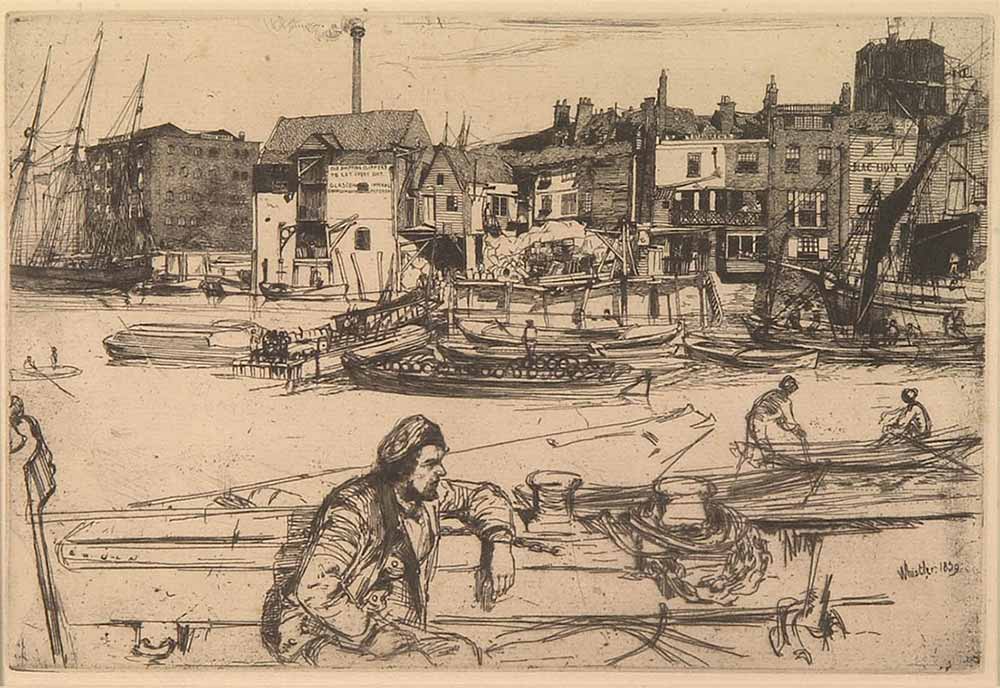
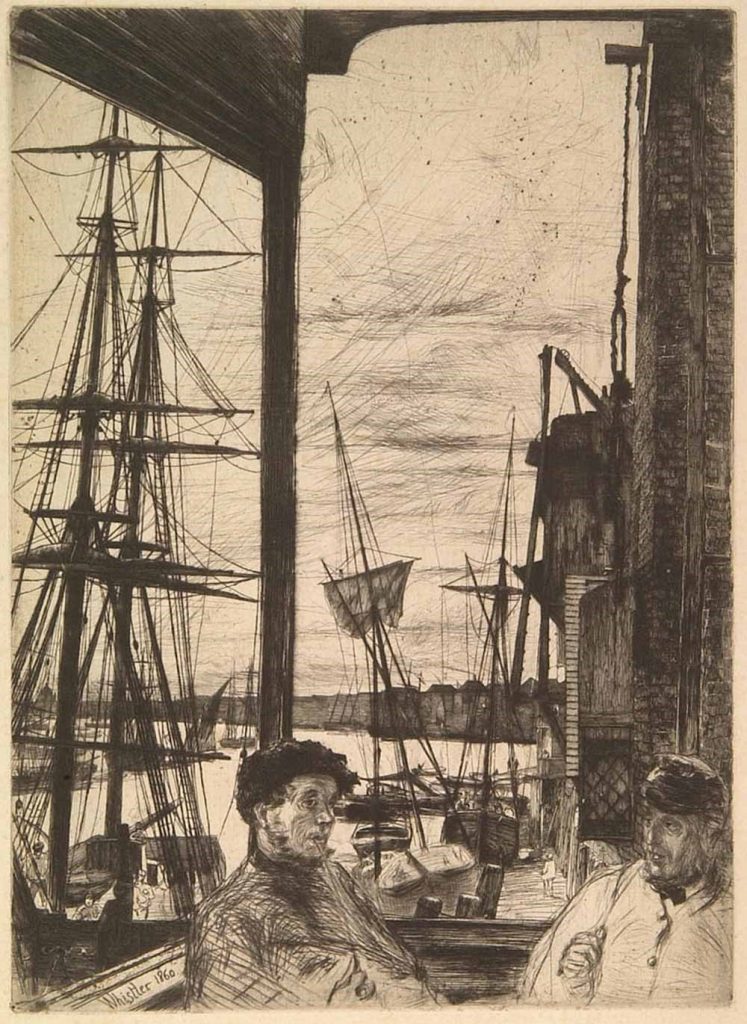


Black Lion Wharf by James Abbott McNeill Whistler
 
James Abbott McNeill Whistler, American (1834-1903). Black Lion Wharf, 1859. Etching on paper, Overall: 5 15/16 x 8 13/16 inches. Purchase: William Rockhill Nelson Trust, 33-284.

James Abbott McNeill Whistler (American, 1834-1903). Rotherhithe, 1860. Etching, Overall: 10 13/16 x 7 3/4 inches. Purchase: William Rockhill Nelson Trust, 33-290.

Doug Osa:

My etching, "11th and Mulberry", will be included in the upcoming show Fine Lines: Whistler and the American Etching Revival on view at the Nelson-Atkins Museum of Art, Kansas City, MO:


Also See


http://www.tfaoi.com/am/5am/5am148.jpg

James McNeill Whistler,The Japanese Dress, 1890s, pencil, black chalk and pastel on brown paper, mounted on board, Bequest of George W. Davison (B.A. Wesleyan 1892), 1952.D1.10;

http://www.tfaoi.com/am/5am/5am149.jpg

J. Alden Weir (1852-1919), The Haystacks, etching and drypoint, some pen and blue ink, working proof, Gift of George W. Davison (B.A. Wesleyan 1892), 1947.D1.249;



Whistler & Company: The Etching Revival

http://www.readingpublicmuseum.org/img/exhibit_whistler_gallery-1.jpg

James Abbott McNeill Whistler (America, 1834 — 1903), Billingsgate, 1859, etching, 5 15/16 x 8 7/8 inches, Museum Purchase, 2003.5.1C

In an open doorway of a shop sits an old woman in right profile, hands in lap, and head bent forward in sleep. On the shelves above and beyond her are various odds and ends.

James Abbott McNeill Whistler (American,1834 – 1903) La Vieille aux Loques (The Old Rag Woman), 1858, etching and drypoint, state: iv/iv, Gift, Kathryn M. Klingeman, 2006.4.1.

 
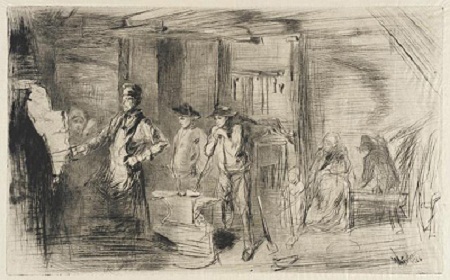
https://lacma.files.wordpress.com/2012/05/the-forge1.jpg?w=600

The Forge (1861)
by James Abbott McNeill Whistler Reading Public Museum

Comments

Popular posts from this blog

Vatican Micromosaic of Saints Valeria and Martial, Rediscovered Masterpiece

Vatican Micromosaic of Saints Valeria and Martial Everyone loves a good story. In the realm of fine art and antiques, a good story, or what we call “provenance”, has the power to take a work of art from exceptional to awe-inspiring. In terms of workmanship, subject matter and sheer size, this incredible micromosaic detailing the Biblical story of Saints Valeria and Martial has it all. Measuring over 10 feet tall, the precision and detail required to execute such a piece is baffling. Combined with the high cost of materials, micromosaics of this immense size and artistry are beyond rare. When you factor in its provenance of being crafted by the prestigious Vatican’s Mosaic Studio and displayed in St. Peter’s Basilica, you’re dealing with an undeniable masterpiece of historical significance. It took a team of seven skilled mosaicists over two and a half years to complete this majestic masterpiece. Given that Vatican relics, especially ones on such a grand scale as this, almost never lea...

Klimt and Schiele: Drawn

Museum of Fine Arts, Boston February 25 through May 28, 2018 Marking the centenary of the deaths of Gustav Klimt (1862–1918) and Egon Schiele (1890–1918), the Museum of Fine Arts, Boston (MFA), presents a special exhibition of drawings on loan from the Albertina Museum in Vienna. Klimt and Schiele: Drawn , on view from February 25 through May 28, 2018 in the Lois B. and Michael K. Torf Gallery, examines the separate, yet parallel experiences of the acclaimed Austrian modernists, as well as the compelling ways in which their work relates—particularly in their provocative depictions of the human body. Organized thematically, the selection of 60 works on paper extends from the artists’ early draftsmanship to explore how each shifted away from traditional training to more incisive and unconventional explorations of humanity over the course of their careers. The MFA is one of three museums—and the only U.S. venue—hosting exhibitions of the Albertina’s rarely loaned drawings b...

Delacroix (1798–1863) at the Louvre

Musée du Louvre, Paris  March 29, 2018 to July 23, 2018 This exhibition is organized by the Musée du Louvre, Paris, and the Metropolitan Museum of Art, New York.  http://presse.louvre.fr/delacroix-1798-1863-2-en/ Eugène Delacroix was one of the giants of French painting, but his last full retrospective exhibition in Paris dates back to 1963, the centenary year of his death. In collaboration with the Metropolitan Museum of Art in New York, the Louvre is holding a historic exhibition featuring some 180 works—mostly paintings—as a tribute to his entire career. From the young artist’s big hits at the Salons of the 1820s to his final, lesser-known, and mysterious religious paintings and landscapes, the exhibition will showcase the tension that characterizes the art of Delacroix, who strove for individuality while aspiring to follow in the footsteps of the Flemish and Venetian masters of the 16th and 17th centuries. It will aim to answer the questions raised by De...